


Introduction
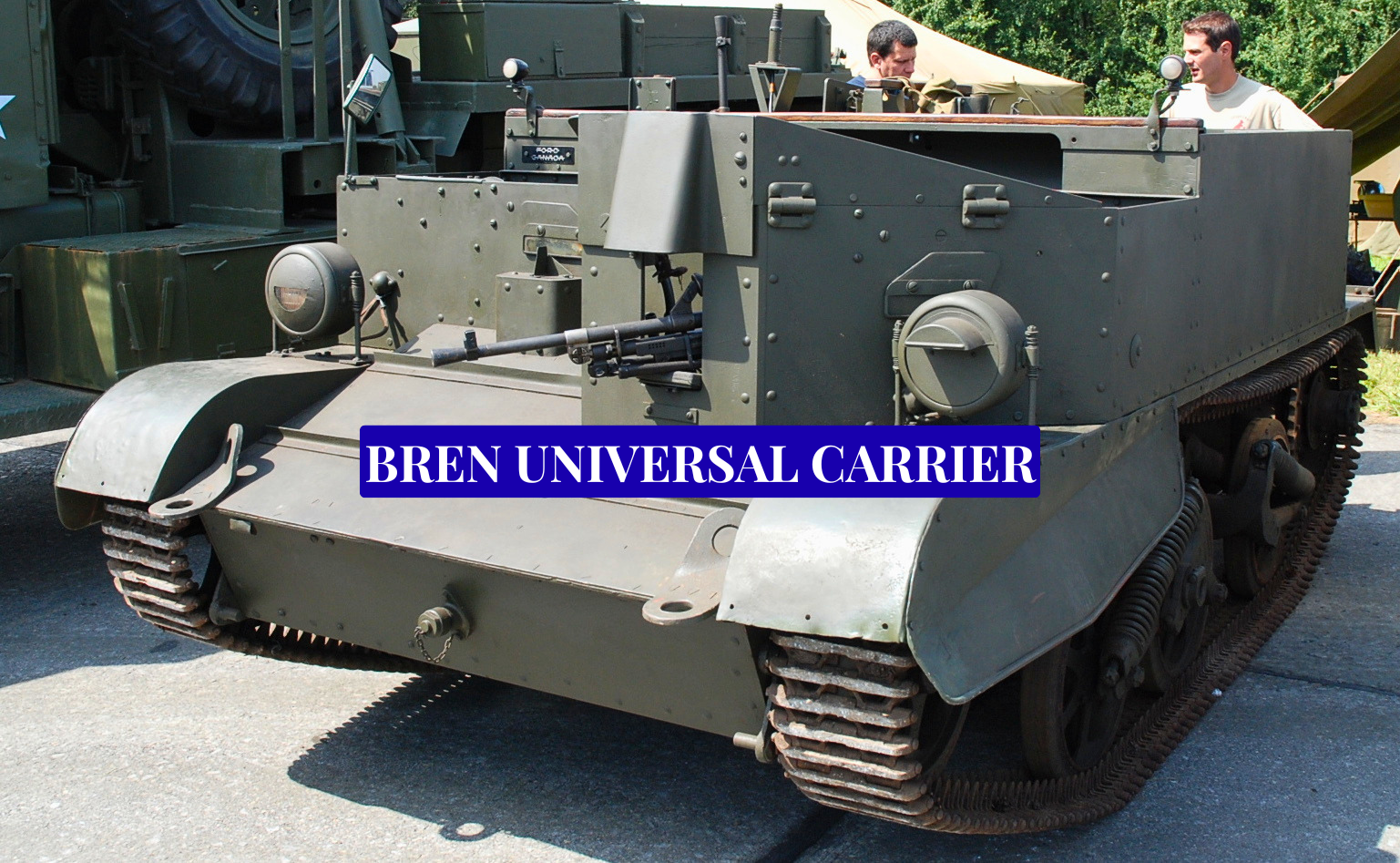
The Bren Universal Carrier was one of the most important light armored vehicles used by Britain and Commonwealth forces during the Second World War. Known for its compact structure, tracked mobility, and battlefield versatility, the vehicle became a reliable support machine in nearly every major military campaign of the era. Although it was never intended to replace tanks or heavily armored fighting vehicles, the Bren Universal Carrier proved extremely valuable for transporting troops, weapons, and supplies across dangerous terrain.
Military historians often describe the Bren Universal Carrier as one of the most practical wartime vehicles ever produced. Its simple design allowed armies to use it for multiple battlefield roles, making it an essential part of infantry operations during World War II.
Origins of the Universal Carrier
The development of the Universal Carrier began during the early 1930s when the British Army started searching for a lightweight armored vehicle capable of improving infantry mobility. Earlier tankette designs, especially the Carden-Loyd series, offered useful ideas but lacked flexibility and carrying capacity. Engineers at Vickers-Armstrong worked to improve the concept and eventually produced a new vehicle that was stronger, more practical, and easier to adapt.
The earliest versions were mainly designed to carry the Bren light machine gun, which is why soldiers began calling it the “Bren Carrier.” Over time, the design evolved into a more universal military platform capable of handling different combat and support roles. This led to the official name “Universal Carrier,” though the nickname Bren Carrier remained popular among troops throughout the war.
Design and Structure
One reason the Bren Universal Carrier became so successful was its practical and straightforward design. The vehicle used a fully tracked system instead of wheels, allowing it to travel effectively across mud, snow, sand, and rough battlefield terrain. This gave infantry units much greater mobility in difficult combat environments.
The carrier featured an open-top structure that made entering and exiting easier for soldiers. While this improved accessibility and visibility, it also left crew members exposed to enemy fire and harsh weather conditions. The driver sat at the front of the vehicle, while the rear compartment could be configured for transporting troops, ammunition, communication equipment, or heavy weapons.
Despite being lightly armored, the vehicle still offered protection against small arms fire and shell fragments. Its low profile also made it harder for enemies to spot from a distance, which increased its survivability during reconnaissance and support missions.
Technical Specifications
Technically, the Universal Carrier was small but highly efficient for its intended battlefield role. The vehicle usually carried a crew of three or four soldiers and weighed approximately 3.5 tons. It measured around 3.7 meters long and about 2.1 meters wide, giving it a compact shape that could maneuver through narrow combat zones and rough terrain with relative ease.
The vehicle was powered by a Ford V8 petrol engine that produced enough speed and reliability for wartime operations. On roads, it could reach speeds close to 48 kilometers per hour, which was impressive for a tracked military vehicle during the 1940s. The lightweight structure of the Bren Universal Carrier allowed it to move quickly while carrying weapons, equipment, or infantry support teams.
Its suspension system was designed to handle difficult terrain while maintaining stability. This feature made it especially effective in environments such as the North African desert and muddy European battlefields.
Weapons and Battlefield Role
The primary weapon associated with the Bren Universal Carrier was the Bren light machine gun. Mounted near the front of the vehicle, the Bren gun provided mobile fire support for advancing infantry units. However, the carrier could also be adapted to transport and operate other weapons depending on mission requirements.
Some versions carried Boys anti-tank rifles, while others transported mortars or communication systems. In certain combat situations, the carrier even supported light anti-aircraft weapons. This flexibility allowed soldiers to transform the vehicle into a reconnaissance platform, supply transporter, or mobile weapons carrier within a short period of time.
The Bren Universal Carrier was especially useful during fast-moving military operations where infantry units needed reliable transportation and rapid deployment. Although it lacked the armor and firepower of tanks, its mobility and adaptability made it a valuable battlefield asset.
Variants and Specialized Models
As the war progressed, multiple variants of the Bren Universal Carrier were created to meet changing battlefield demands. Engineers modified the original platform for specialized military roles, making it one of the most adaptable vehicles of World War II.
Some carriers were designed specifically for transporting infantry and equipment, while others were converted into mortar carriers or command vehicles equipped with communication radios. Ambulance variants were also developed to evacuate wounded soldiers from combat zones quickly and safely.
One of the most famous specialized versions was the “Wasp” flamethrower carrier. Equipped with a flamethrower system, the Wasp variant was used during close-range assaults against fortified enemy positions. Its psychological impact on enemy forces made it particularly feared during combat operations.
These adaptations demonstrated the remarkable flexibility of the Bren Universal Carrier, allowing the same base vehicle to perform many completely different military tasks.
Use During World War II
The Universal Carrier served in nearly every major theater of the Second World War. British and Commonwealth forces relied heavily on it throughout Europe, North Africa, and Asia. In European campaigns, the vehicle transported ammunition, carried support weapons, and assisted infantry advances during large-scale offensives.
In North Africa, the carrier’s speed and tracked mobility proved highly effective in desert warfare. It could move quickly across sandy terrain where wheeled vehicles often struggled. Soldiers appreciated its reliability during long-range operations under extreme conditions.
The vehicle also saw extensive use in jungle warfare across Southeast Asia and the Pacific region. Its compact design allowed it to navigate narrow jungle paths while carrying supplies and communication equipment to frontline troops.
Throughout the war, the Bren Universal Carrier became known as a dependable support vehicle capable of adapting to almost any combat environment.
Strengths and Weaknesses
Like every military vehicle, the Universal Carrier had both strengths and limitations. Its greatest advantages included speed, flexibility, affordability, and ease of production. Because the design was simple, factories could manufacture large numbers quickly during wartime emergencies.
Its compact size also made it difficult for enemies to target from long distances. Combined with excellent mobility, this gave troops the ability to reposition quickly during combat operations.
However, the carrier’s weaknesses were equally clear. The thin armor could not withstand heavy machine gun fire or anti-tank weapons, and the open-top compartment exposed soldiers to artillery fragments and grenades. The vehicle was never intended for direct combat against tanks or fortified positions.
Despite these weaknesses, military commanders continued using the Bren Universal Carrier because its practical benefits outweighed its vulnerabilities in most support roles.
Production and International Use
One of the most remarkable achievements of the Bren Universal Carrier program was its enormous production scale. More than 100,000 units were built during and after World War II, making it one of the most-produced armored vehicles in military history.
Production took place across Britain, Canada, Australia, and several Commonwealth nations. This international manufacturing effort ensured a steady supply of vehicles throughout the war.
The carrier was used not only by British forces but also by Canadian, Australian, New Zealand, Indian, and Polish units. Many Allied armies valued the vehicle because of its reliability, low operating cost, and adaptability under battlefield conditions.
Post-War Service and Legacy
After World War II ended, many Bren Universal Carrier remained in military service for decades. They participated in conflicts such as the Korean War and were also used during colonial operations in Africa and Asia. Some armies continued operating them for training purposes long after newer armored vehicles entered service.
Surplus carriers were occasionally converted for civilian applications, particularly in agriculture and industrial work where tracked mobility was useful. Farmers and engineers found the vehicles capable of operating effectively on difficult ground.
The long-term influence of the Bren Universal Carrier can still be seen in modern armored personnel carriers and infantry support vehicles. Its core design philosophy—mobility, adaptability, and multi-role functionality—continues to shape military vehicle development today.
Final Thoughts
The Bren Universal Carrier remains one of the most successful support vehicles ever developed during the Second World War. While it was small, lightly armored, and mechanically simple, its battlefield impact was enormous. It provided infantry forces with mobility, logistical support, and tactical flexibility at a time when rapid movement was becoming increasingly important in modern warfare.
Even decades after the war, surviving carriers continue to appear in museums, military exhibitions, and historical reenactments around the world. Their continued preservation reflects the important role they played in military history.
The legacy of the Bren Universal Carrier proves that effectiveness in warfare is not always measured by heavy armor or massive firepower. Sometimes, reliability, adaptability, and smart engineering are what truly define a legendary military vehicle.

